
In the 1990s, most Bollywood movies had a strong focus on romance. The hero and heroine would meet, argue at first, gradually fall in love, face parental conflicts, and finally marry. This repetitive pattern was widely followed in films of that era. Back then, movies were mostly seen as a source of entertainment. Few people paused to consider the subtle, long-term impact – Bollywood’s impact on kids.
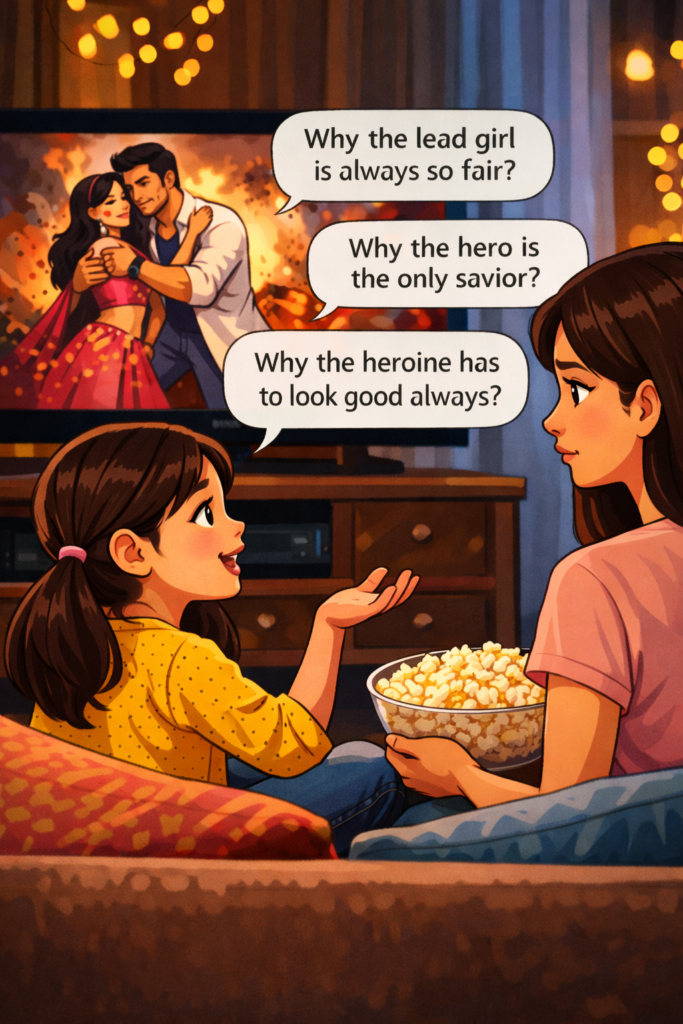
Not long back, I used to watch Bollywood movies with my eight-year-old child. Initially, I felt like I was simply introducing her to the films of our time and giving her a glimpse of that familiar cinematic world. We watched them together, and she enjoyed the catchy songs, energetic dances, and elaborate outfits worn by actors at unusual events. The sudden interruption of scenes with song sequences often made her raise her eyebrows in surprise. In addition, the stereotypical portrayals—such as women sacrificing everything for the family or the hero always rescuing the heroine—were common themes throughout these films.
The Realization
At first, it did not seem harmful. However, everything changed when she began asking astonishing questions. Her questions brought me to my senses. She asked, “Why is the heroine always so beautiful?” “Why do they always eventually fall in love?” “Why does she always accept things even when they are not right?” She also wondered why the hero always helps the heroine and why the situation never happens the other way around. Finally, she asked why the heroine leaves everything behind to go with the hero.
These innocent yet thoughtful questions made me realize how deeply these repeated patterns can influence young minds. What once felt like simple entertainment began to feel more meaningful and impactful than I had initially considered.
Children today are remarkably perceptive. They can observe patterns, understand subtle messages, and question what does not make sense to them. Unintentionally, cinema has often presented irrational ideas that reinforce stereotypical conditioning in kids.
Gender Roles in Bollywood Films
Cinema usually portrays the male protagonist as strong, dominant, and the ultimate savior. In contrast, female characters are often depicted as soft, sacrificial, submissive, and dependent. The “ideal” woman sacrifices her dreams for her family. She tolerates disrespect and hardship silently and seeks family approval in nearly every decision. Meanwhile, the hero fights, protects, and dominates the story.
Such repeated portrayals create a rigid image of how men and women are expected to behave. Children may internalize the belief that masculinity must always be powerful and aggressive, while femininity must be gentle and self-sacrificing. Over time, these narrow definitions can blur young minds, making them believe their identity must fit within predefined societal roles instead of developing as individuals.
Unrealistic Beauty Standards
The female protagonist is often presented as the epitome of beauty—fair-skinned, slim, and docile. Less conventionally attractive characters, including darker-skinned or heavier individuals, are often supporting characters or villains. They are sometimes made the target of jokes, reinforcing harmful stereotypes.
With such constant portrayal, children may unconsciously conclude that acceptance depends on fitting conventional beauty standards. This is not a healthy foundation for character building. Instead of embracing their natural appearance, children may feel pressured to alter themselves. Gradually, the desire to “fit in” can overshadow authenticity, preventing them from being their true selves.
Unrealistic Love Expectations
Love in Bollywood movies often seems powerful enough to overcome family opposition, logic, career ambitions, and personal values. Marriage is shown as the ultimate happy ending.
These portrayals may create unrealistic expectations. Children may believe love alone solves every problem, overlooking the importance of communication, compatibility, respect, and emotional maturity in real-life relationships.
Women’s Sacrifice
Another recurring theme is glorifying women’s sacrifice. The “ideal” woman puts her family’s needs above her own aspirations. She endures hardship quietly and measures her worth through family approval. Acceptance often comes only when she conforms to societal expectations and norms.
Repeated messages like this can teach children that a woman’s value depends on her ability to compromise and adjust, rather than her individuality, ambition, or personal happiness. This may lead children to seek validation even when it goes against their own wishes.
Blurring Boundaries
In many stories, the hero sees the heroine, becomes instantly attracted, and goes to great lengths to gain her attention and approval. This pursuit is often portrayed as passionate and romantic, even when it involves ignoring rejection, following her persistently, or crossing personal boundaries. Eventually, after resistance and misunderstandings, the heroine falls deeply in love.
As a result, persistence is glorified as proof of love. This portrayal can blur children’s understanding of consent and mutual respect. They may unconsciously learn that boundaries are flexible and that continued pressure is normal to win someone’s affection.
Unrealistic Life Portrayals
There are several other aspects that create an unrealistic picture of life. Films often present an idealized version of reality rather than what life actually is. This can lead children to form a somewhat delusional perception of how life should be instead of encouraging them to accept reality.
Another aspect that is difficult to ignore is the presence of Bollywood’s infamous item songs. In many of these dance numbers, filmmakers portray women mainly as objects of visual attraction rather than meaningful characters within the story. Moreover, the lyrics in many of these songs are often preposterous and inappropriate; however, audiences frequently overlook them because they appear in an entertaining format. Consequently, although consuming such content may not seem harmful at first, repeated exposure can gradually shape an unhealthy perception of how women should be viewed and valued.
Nevertheless, it is important to acknowledge that many movies have also served as a source of inspiration for young minds. Beyond entertainment, they often convey messages about perseverance, ambition, patriotism, and resilience. Some films showcase characters overcoming challenges, pursuing their dreams against all odds, or standing up for what is right. In addition, a few movies use comedy to convey subtle messages, blending entertainment with gentle life lessons that children can easily understand. These stories can spark curiosity, encourage critical thinking, and inspire children to act with courage and kindness.
The Takeaway: Guiding Young Minds
In retrospect, an important question arises: what can parents do? One effective approach is to mindfully monitor the content children watch. Parents can encourage films and shows that build character, inspire curiosity, and promote logical thinking. Entertainment can still be fun and humorous without sending confusing or harmful messages.
At the same time, shielding children from everything is neither practical nor necessary. What matters more is communication. By discussing movies and helping children question what they see, parents can guide them to distinguish between fiction and reality, fantasy and values.
Parents should not prevent children from watching movies. Instead, they should provide a framework to help them recognize what is beneficial and analyze what may not be.
Note: For more guidance on media and children, parents can refer to UNICEF’s Media Guidelines for Children.