
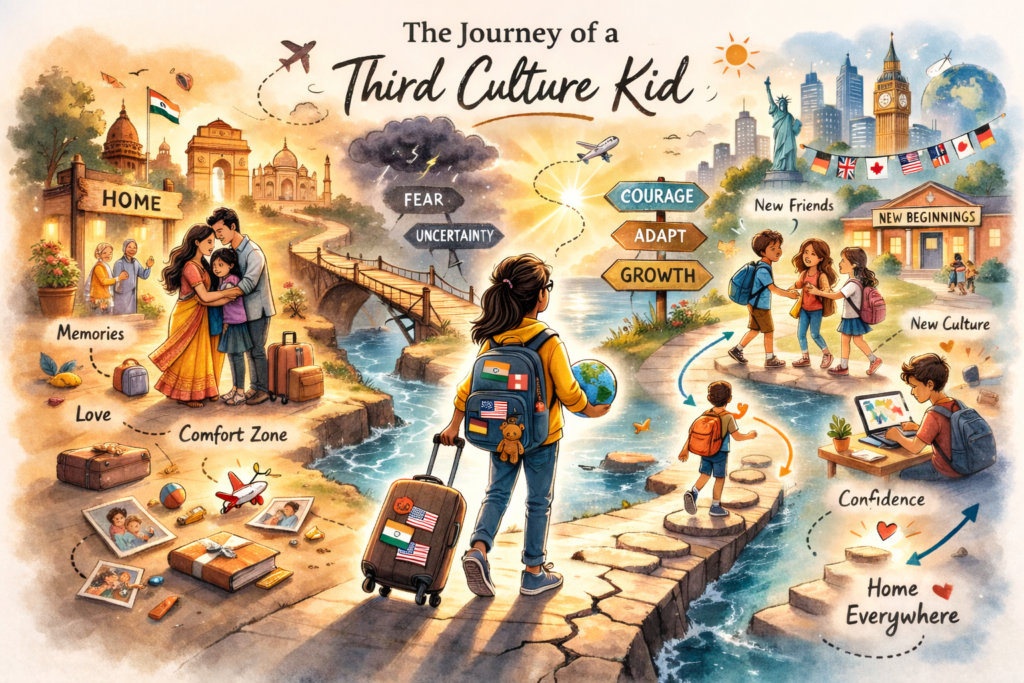
AI-generated illustration
Home, for me, was always one fixed address. I grew up surrounded by the same people, the same friends, and familiar surroundings. As a result, my childhood was rooted in consistency, comfort, and stability. I never imagined that life would later introduce me to a completely different experience — one that would help me better understand the lives of Third Culture Kids.
After marriage, life took a completely new direction. I began relocating to different countries and, trust me, it was uncomfortable at first. Loneliness hit me hard. I was not open to the new culture, and I constantly missed the people back home.
In hindsight, it was obvious why. I had never stepped outside my hometown before. And suddenly, such a massive shift hit me all at once. I was unprepared for it. I was not ready.
However, everything changed when I became a parent. After the birth of my daughter, conversations around me shifted, and many people encouraged me to settle down in one stable place. At that time, I too felt drawn toward permanence, largely because that was how I had been raised.
Later, when the opportunity arose to relocate again, I was initially reluctant. Nevertheless, after thoughtful consideration, I decided to move forward, as better opportunities awaited us. Still, this decision came with concerns, especially regarding my daughter’s adjustments — leaving grandparents, siblings, friends, and schools behind; adjusting to new environments; and rebuilding a sense of belonging in unfamiliar places. I wondered how she would adapt to a different lifestyle, climate, and culture, and whether she would be able to form meaningful connections again.
Facing the fear
As feared it was quite a journey to adjust.Missing family and friends back home.Feeling alone in the first few weeks of new school.Difficulty in making new friends.Trust me when I say I used to break a little by little everyday seeing her.We had to make her understand a lot of times that it will take time but you will like it here eventually.Sometimes the relocating decision would feel wrong.But,It was my husband who made me understand that exposure builds character.She will learn to handle people.She will learn new perspectives of people,She will get exposed to new culture ,new lifestyle
The Conversations
My husband, army-bred though he never moved with his father, approaches life with discipline and clarity.In military households, they often say, “Change is not disruption; it is rhythm.” That perspective deeply shaped the way he viewed relocation and uncertainty.
As a mother, however, I naturally responded emotionally, while he approached the situation with calm logic. Whenever my worries surfaced, he would patiently reason through them.
For instance, I would ask, “What if she gets bullied?” To that, he would reply, “Then she will learn how to stand up to bullies.”
At other times, I would worry, “What if she feels lonely?” In response, he would reassure me, “We will make sure she develops a skill or hobby that helps her connect and build confidence.”
Similarly, when I feared, “What if she struggles to express her opinions?” he would calmly say, “She will learn how to communicate and handle different kinds of people.”
While I focused on protecting her from discomfort, he focused on preparing her for the world. Gradually, I began to understand that resilience is often built not in comfort, but in transition.
The Turning Point
As time passed, I slowly began to understand what he had meant. Gradually, I saw the changes unfold before my eyes. I watched her build meaningful friendships and grow comfortable in unfamiliar spaces. She began appreciating the culture of the new country and adapting in her own quiet way.
It was then that I began to truly understand the quiet power of Third Culture Kids. They may take time to adjust, but in doing so, they develop remarkable resilience. They learn to read social cues, adapt to different environments, and build connections across cultures. Rather than being overwhelmed by change, they gradually become strengthened by it.
I realized that what once felt like instability was, in reality, shaping her into a globally aware, emotionally intelligent, and adaptable individual.
Third Culture Kids
Third Culture Kids are children who grow up in a culture different from their parents’ home culture. As a result, they learn to build an identity that blends both — they remain rooted in their family’s traditions while adapting to the culture of the country they live in. Over time, they develop a unique “third culture” — one that is neither entirely their parents’ nor entirely their host country’s, but a thoughtful mix of both.
Like any experience, the life of Third Culture Kids (TCKs) comes with both strengths and challenges. Let us begin with the challenges.
One of the most difficult aspects is the struggle to build long-term friendships. Frequent relocations often interrupt deep-rooted connections, and the transition period requires time and emotional energy. Additionally, many TCKs may feel that they do not fully belong to any one culture. They are rooted in their parents’ heritage while simultaneously adapting to the culture of the country they are living in. As a result, this duality can sometimes create a sense of fragmented identity or a lingering feeling of not fully belonging anywhere.
However, alongside these challenges come remarkably powerful strengths.
TCKs often develop exceptional resilience. Because change becomes a constant part of their lives, they learn to adapt quickly and confidently to new environments. Over time, they become effective communicators, capable of understanding diverse perspectives and navigating different social settings with ease. Furthermore, they tend to grow independent at an early age, learning to rebuild comfort and connection wherever they go.
Another Relocation
After three and a half years in the United States, it was time for yet another relocation. The same questions resurfaced, and the same fears crossed our minds. However, this time, something had changed — both in me and in my daughter.
I noticed that resistance had slowly transformed into acceptance. Problems began turning into solutions. Self-doubt gradually gave way to confidence. Witnessing this shift changed my perspective as well. I saw my child growing out of her insecurities and stepping into her own strength.And somewhere along the way ,I found myself evolving with her .
It also made me reflect on something deeper: we spend our entire lives striving for stability, comfort, and certainty. Yet how often do we prepare ourselves — or our children — for uncertainty?
Krishna Teaching

As I reflect on this journey, I often think about the deeper message Krishna conveys in the Mahabharata — that love should not become overprotection. Providing comfort and stability is natural for any parent. However, perhaps our greater responsibility lies in building strength, not shields.
Instead of building luxuries for our children, perhaps we should build their capability to earn those luxuries themselves. Instead of shielding them from every difficulty, we can teach them to recognize right from wrong, understand their responsibilities, and develop a strong moral foundation.
Rather than giving them a life of guaranteed comfort, we can give them the wisdom to create comfort wherever they go. Because when the world shifts — as it inevitably does — knowledge, character, and resilience will serve them far more than protection ever could.
When raising Third Culture Kids, this realization becomes even more profound. Their lives are shaped by movement, transition, and cultural shifts. Instead of anchoring them to one fixed ground, we teach them how to remain steady when the ground itself changes. Instead of guaranteeing lifelong comfort, we nurture resilience, adaptability, and inner confidence.
Final Thoughts
I ,recall powerful words often attributed to Charles Darwin:
“It is not the strongest of the species that survives, nor the most intelligent — it is the one most adaptable to change.”
Perhaps that is the true inheritance we can give our children. Not a perfectly stable world, but the tools to create stability within themselves. Not protection from uncertainty, but the courage to face it.
And in raising Third Culture Kids, maybe we are not disrupting their lives — we are quietly preparing them for a world that never stands still.